
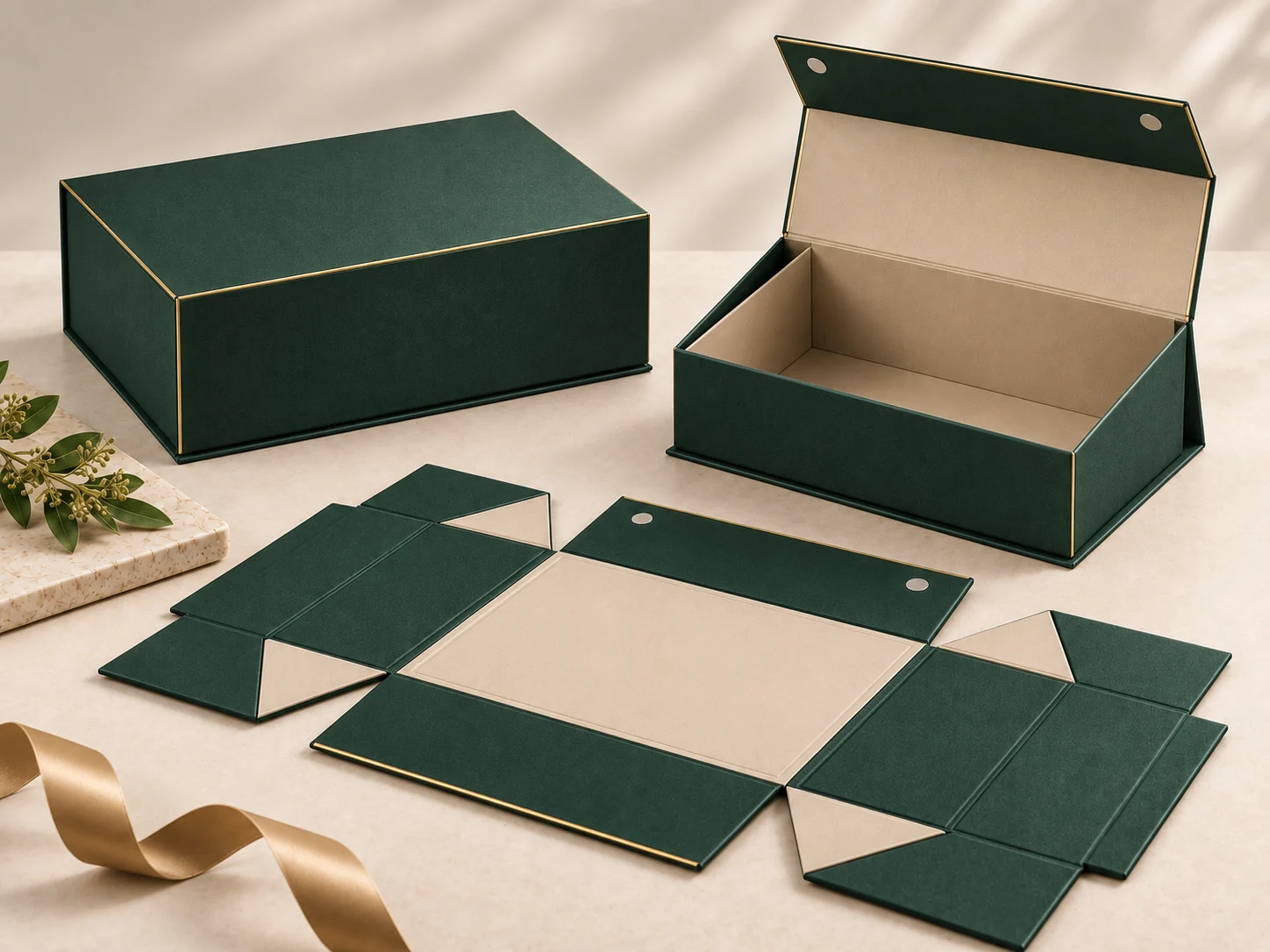
Flat-packed rigid boxes are designed to combine rigid-style presentation with storage and delivery before final assembly. Brands may consider them when shipping-volume efficiency and available storage space are important alongside the finished appearance.
The trade-off is that assembly takes place before packing, often at the location where the products are packed. Choosing this approach means considering the box, the people assembling it and the complete packing process.
1. What Is a Flat-Packed Rigid Box?
A flat-packed rigid box is designed to remain flat or partially collapsed during storage and transport, then be assembled into a rigid-style presentation box before use.
Specific construction can vary by box style. Folding areas, separate components and forming steps should be reviewed for the selected design; not every foldable rigid box uses the same structure.
2. Main Benefits of Flat-Packed Rigid Boxes
Reduced Storage Volume
Flat-packed structures can reduce the space required before assembly compared with keeping the equivalent boxes fully formed. The practical storage benefit depends on the design, number of components and how the packs are arranged.
More Efficient Shipping Volume
Flat-packed delivery may improve shipment space utilization compared with fully preformed rigid boxes. Actual shipping arrangements still depend on the packed dimensions and project conditions, so reduced volume should not be treated as a promise of a particular freight saving.
Premium Presentation
After assembly, the box can retain a substantial rigid-style appearance. Review the assembled form and opening experience against the intended presentation goals rather than judging only the flat components.
Flexible Structural Options
Existing options include foldable drawer-style and lid & base structures. Other foldable rigid concepts should be discussed against confirmed project capability rather than assumed to use the same construction.
3. Limitations to Consider
Assembly Is Required
The box must be formed before packing, which adds a handling step. Identify who will assemble it, where that work will happen and how the step fits into the packing workflow.
Structure Depends on Design Quality
Alignment, folding and forming depend on a well-designed structure and production quality. The assembly arrangement should be reviewed as part of the project, together with how the finished box will hold its contents.
Not Every Product Is Suitable
Some product sizes, weights or packing methods may be better suited to another format. Evaluate the actual product and packing arrangement rather than selecting a box only because it can be delivered flat.
Presentation May Differ From Fully Preformed Rigid Boxes
Folding and assembly features can give a flat-packed design a different construction and presentation from a fully preformed box. Neither approach is automatically preferable; compare the finished appearance and opening experience required for the product.
4. Flat-Packed Rigid Boxes vs Conventional Rigid Boxes
This comparison describes flat-packed delivery against conventional preformed rigid boxes. Actual volumes and packing steps depend on the selected design and packing arrangement.
| Factor | Flat-Packed Rigid Boxes | Conventional Rigid Boxes |
|---|---|---|
| Storage | Flat-packed before assembly; more space-efficient | Preformed; requires more storage volume |
| Shipping Volume | Lower before assembly | Higher due to formed structure |
| Assembly | Required before use | Usually ready formed |
| Presentation | Rigid-style presentation after assembly | Traditional rigid presentation |
| Packing Process | Includes an assembly step | Simpler at packing stage |
| Typical Applications | Export, gifting, e-commerce and retail projects | Premium presentation and gift packaging |
5. When Flat-Packed Rigid Boxes May Be a Good Fit
Flat-packed rigid boxes may be suitable for:
- export-oriented packaging projects
- gift sets
- retail packaging
- e-commerce projects
- projects with limited storage space
- projects needing rigid presentation with flat-packed delivery
These applications still need a suitable assembly process. Consider the benefit before assembly alongside the work needed to prepare the boxes for packing.
6. When Another Structure May Be Better
Another packaging format may be preferable when:
- no assembly step is desired
- fast packing is a priority
- a simpler retail carton is sufficient
- product size or weight requires a different structure
Compare Folding Cartons and the Rigid Boxes family in the context of the actual workflow. For a broader framework, read How to Choose the Right Packaging Structure for Your Product.
If you are still comparing the broader box families, Folding Cartons vs Rigid Boxes: Which Should You Choose? covers their presentation and packing trade-offs.
7. Common Flat-Packed Rigid Box Structures
Foldable Drawer Rigid Boxes

A drawer-style box uses a sleeve-and-tray presentation. A foldable construction brings assembly into the preparation process while retaining the intended presentation once formed.
Review Foldable Drawer Rigid Boxes when this opening style fits the product and packing arrangement.
Foldable Lid & Base Rigid Boxes

A lid & base box offers a two-piece presentation. A foldable structure allows flat-packed storage and delivery before the components are formed for use.
See Foldable Lid & Base Rigid Boxes to discuss this format and its assembly requirements.
8. Questions to Ask Before Choosing
- What product will the box hold?
- What are the product dimensions and weight?
- Is flat-packed delivery important?
- Who will assemble the box?
- How quickly does packing need to be completed?
- What presentation level is required?
- What quantity is planned?
- What printing and finishing are required?
Conclusion
Flat-packed rigid boxes can offer storage and logistics advantages while maintaining rigid-style presentation, but the suitable structure depends on product requirements, assembly, presentation goals and project conditions.
They are not suitable for every project. Consider the product, assembly requirements, presentation goals, storage, logistics and production requirements together before choosing the format.